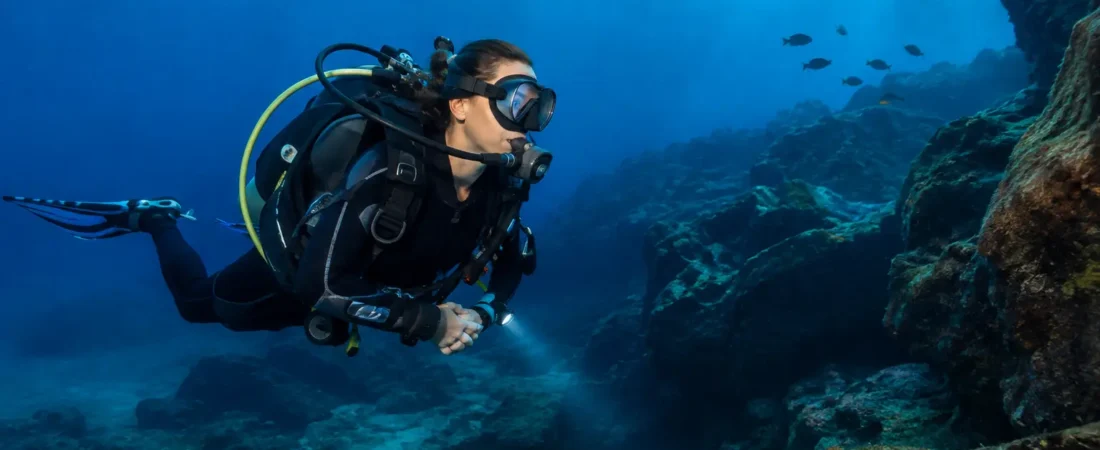
When the last swimmers have left the beach and the surface becomes quiet, night diving Tenerife reveals a very different side of the Atlantic. Familiar reefs and volcanic rock formations feel new under the beam of a torch. Small creatures that remain hidden during the day begin to move, while the noise and pace of a busy holiday day fade away.
A night dive is not about going deeper or making the experience more extreme. Done with the right preparation, it is a calm, close-up dive with a guide who knows the site, the entry and the conditions. For certified divers staying in Los Cristianos, Playa de las Américas or Costa Adeje, it can be one of the most memorable ways to spend an evening in South Tenerife.
What makes night diving in Tenerife different?
Daytime diving often gives you the wider picture: the blue water, the reef layout and fish moving in open water. At night, your attention narrows naturally to what the torch illuminates. You notice textures on the volcanic seabed, the movement of a small crab between rocks, and fish resting in sheltered places.
The water itself does not suddenly become unrecognisable after sunset. On a well-planned shore dive, the route is usually simple and familiar to the instructor. The difference is the atmosphere. With a focused beam of light and fewer visual distractions, many divers find they slow down, improve their buoyancy awareness and become more attentive to the details around them.
Tenerife’s generally mild water temperatures make evening diving possible throughout much of the year, although comfort still depends on the season, your exposure protection and how easily you feel the cold. Wind, swell and visibility matter more than a date on the calendar. A responsible operator will choose the site only when conditions are suitable, or suggest another plan if they are not.
Who is a night dive best suited to?
Night diving is normally best for certified divers who are comfortable with their basic skills, including mask clearing, buoyancy control and communicating underwater. You do not need to be an advanced diver or have hundreds of logged dives. But you should feel relaxed enough in the water that adding darkness does not make every task feel rushed.
If you have recently qualified, a private guided night dive can be a sensible first step. A dedicated instructor can keep the group small, explain the route carefully, allow time to settle in at the surface and adjust the pace to your confidence. This is very different from following a large group in a hurry.
For complete beginners, a first scuba experience is usually more enjoyable in daylight. Visibility, orientation and communication are easier to understand when you are learning the basics for the first time. After a private try dive or beginner scuba session, you will have a much clearer sense of whether further training and a future night dive appeal to you.
There is also a personal side to the decision. Some divers love the quiet concentration of darkness; others discover that they prefer broad daylight and open views. Neither choice is better. The aim is to choose an experience that feels exciting without pushing beyond your comfort level.
What you might see after sunset
Marine life is never guaranteed, and that unpredictability is part of real diving. The appeal of an evening dive is not a promise of a particular animal but the chance to observe different behaviour. Octopus, crabs, shrimps and other small nocturnal creatures may be more active, while some fish rest in crevices or hover close to the reef.
A torch also brings out colours that can appear muted at depth during the day. Reds, oranges and pinks on rocks and marine life become more noticeable in the light. Keep your movements gentle and your beam considerate. Pointing a powerful light directly into an animal’s eyes for long periods is unnecessary, and a good guide will help you observe without crowding wildlife.
Occasionally, switching off torches for a moment in safe, close formation can reveal tiny flashes of bioluminescence as you move your hands through the water. It is a lovely detail when conditions allow, but it should always be done under the instructor’s direction and never at the expense of orientation or safety.
How a private night dive should be organised
The best night dives begin before you enter the sea. Your instructor should check your certification and recent diving experience, discuss any concerns, assess conditions and give a clear briefing. You should know the planned maximum depth, route, expected dive time, hand signals, torch signals and what happens if you become separated from your buddy.
Each diver needs a reliable primary torch, while the guide should carry backup lighting and an appropriate surface signalling device. Equipment checks matter even more after dark. Before the entry, take time to confirm that your torch is working, your cylinder is open, your weights are secure and nothing is dangling where it could catch on rocks.
The entry and exit should be uncomplicated. A private experience allows time for a calm shore entry, a short surface check and an unhurried descent. Underwater, the group stays close together. Rather than covering a long distance, a good guided night dive often explores a compact area thoroughly, returning along a route the guide knows well.
Photography can be possible, but it is worth managing expectations. Low-light underwater images require suitable equipment and careful lighting, and stopping repeatedly for photos can distract from buoyancy and buddy awareness. If holiday photos matter to you, mention this before booking so the dive can be planned realistically.
Practical questions before you book
Ask whether the dive is private or shared, who will be guiding you and how many divers will be in the water. For a first night dive, personal attention is particularly valuable. It gives you more space to ask questions and means the instructor can adapt the pace if you need a moment to settle.
It is also sensible to ask what equipment is included, whether transport can be arranged from your area in South Tenerife and what happens if sea conditions are not suitable. Clear answers are a good sign. No operator can control the ocean, but a professional team can make sensible decisions before anyone gets in the water.
Be honest about your experience, especially if you have not dived for several months, feel nervous in the dark or are unsure about your certification level. A refresher dive in daylight may be the better choice before an evening dive. Likewise, follow standard diving advice on fitness to dive, hydration and leaving adequate time before flying after diving.
A quieter way to experience South Tenerife
For certified divers, night diving in Tenerife can be a refreshing alternative to another daytime reef dive. It trades wide views for small moments: a torch beam across black volcanic rock, a resting fish in a sheltered corner, and the calm feeling of returning to shore while the coastline lights up.
Lov’Ocean can help certified divers decide whether a private guided evening dive suits their experience and the conditions on the day. A short conversation before booking is often all it takes to choose between a night dive, a daylight guided dive or a relaxed refresher first.
If darkness makes you curious rather than uneasy, choose a small, well-briefed dive and give yourself permission to go slowly. The best night dives are not rushed adventures. They are careful, quiet experiences that let Tenerife’s underwater world speak for itself.