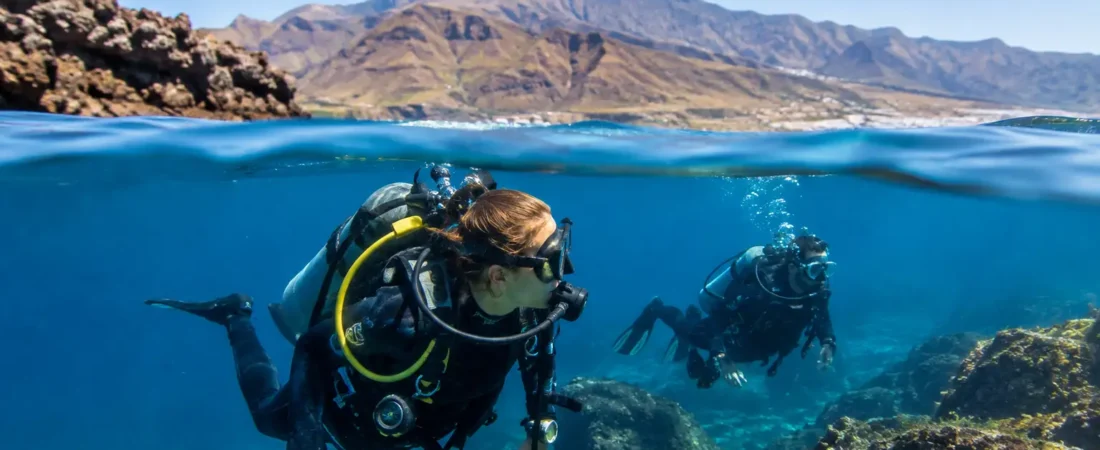
A certified diver excursion should feel like the easy part of your Tenerife holiday: a well-planned day in the water, guided by someone who understands the coast, the conditions and your comfort level. Rather than spending valuable holiday time working out where to go, what to bring or whether a site suits your certification, you can arrive ready to enjoy the experience.
For qualified divers, Tenerife offers a remarkable underwater landscape shaped by volcanic history. Dark rock formations, natural arches, lava shelves and clear Atlantic light give each site its own character. The right excursion is not simply about choosing a beautiful location. It is about selecting the right location for you, on the day you dive.
What a certified diver excursion should include
A good guided dive begins well before entering the sea. Your instructor or guide should take time to understand your certification, recent diving experience, confidence in the water and any preferences you may have. A diver returning after a long break may appreciate a gentler first descent and extra time to settle in. A regularly active diver may be looking for a more varied route or a site with interesting volcanic relief.
This conversation matters because conditions around Tenerife change with the wind, swell and visibility. There is no single “best” site every day. Local knowledge makes it possible to choose a setting that feels comfortable and rewarding, rather than forcing a fixed plan when the sea suggests a better option.
At Lov’Ocean, guided dives are designed around that personal approach. Equipment is included, so there is no need to travel with heavy kit unless you prefer using your own. The experience is organised with care, from the briefing and equipment check to the pace underwater and the moments after the dive. Underwater photographs are also included, giving you a thoughtful record of the day without asking you to manage a camera yourself.
Why Tenerife suits qualified divers
Tenerife’s southern coastline is particularly appealing for divers who enjoy natural volcanic scenery without needing an extreme expedition. The underwater topography can change beautifully over a short distance: rocky reefs lead to sandy areas, lava formations create shelter and small marine life appears in the details of the landscape.
The Atlantic is always in charge, of course. Visibility, currents and sea state vary by season and by location. That is part of what keeps diving here interesting, but it is also why a local guide adds real value. They can read the conditions, adapt the plan and make sensible decisions without making the day feel complicated.
For guests staying around Los Cristianos, Costa Adeje, Playa de las Américas or Palm-Mar, a well-organised excursion can fit naturally into a holiday schedule. You do not need to turn your whole day upside down to enjoy a quality dive. The focus is on making the experience relaxed from the outset.
Volcanic sites offer more than a backdrop
Volcanic diving is not just about dramatic photographs, although Tenerife certainly offers memorable underwater scenes. Rock structures influence how light moves, where fish shelter and how a route unfolds. A guide who knows the site can point out details that are easy to miss, while leaving enough quiet space for you to enjoy the feeling of being underwater.
Marine sightings are never guaranteed, and a responsible guide will not promise a particular animal. What can be promised is attention: looking carefully, moving calmly and choosing a route suited to the conditions can make every dive feel richer. Sometimes the most memorable moments are small – a school moving over a ridge, the texture of lava rock in clear water or the stillness of a sheltered bay.
How to choose the right excursion for your experience
Your certification card is a useful starting point, but it does not tell the whole story. If you have not dived for several months or years, say so when booking. There is no judgement in needing a little more time. A considerate instructor can adjust the briefing, review key skills if appropriate and select a setting where you can regain your rhythm comfortably.
It is equally helpful to be honest about what you enjoy. Perhaps you prefer a slow, scenic dive with plenty of time to observe. Perhaps you are keen to explore volcanic formations and would like a site that feels more adventurous while remaining suitable for your level. Clear communication helps create an excursion that feels personal rather than standardised.
A premium experience is often defined by these quieter details: equipment that fits properly, a briefing that is clear rather than rushed, a guide who notices when you need a moment, and enough time to enjoy the water at your own pace. For many divers, those details make a far greater difference than trying to fit as much as possible into one outing.
Preparing for your guided dive
Preparation should be simple. Bring your certification card or digital proof of certification, logbook if you use one, swimwear, a towel and sun protection for before and after the dive. If you have your own mask, it can be worth bringing it if you know it fits you perfectly, although suitable equipment is provided.
Before the excursion, avoid arriving dehydrated or exhausted from a late night. Eat something light, drink water and allow enough time to arrive without stress. If you are taking medication, have a medical condition or have had a recent illness, mention it in advance so your instructor can advise you properly. Safety is most effective when it is part of an open conversation, not an awkward last-minute surprise.
Your briefing should cover the plan for the site, entry and exit, communication underwater, depth and timing, as well as what to do if conditions change. It should be clear and accessible, even if you have completed many dives before. The goal is not to overload you with information. It is to ensure that you feel informed, calm and ready.
A note on pace and confidence
Every diver has a different relationship with the water. Some are immediately at ease; others need a few minutes at the surface before descending. Both are completely normal. A guided excursion works best when there is room for your pace, rather than pressure to follow someone else’s.
That flexibility is especially valuable for couples or friends with different levels of recent experience. With attentive supervision and a suitable site choice, the experience can remain enjoyable for both divers. The plan may be adjusted, and that is a sign of good judgement, not a compromise.
Make the most of your time underwater
Once you are beneath the surface, slow down. Look into crevices, along the edge where rock meets sand and towards the water above you. Tenerife’s volcanic environment rewards patience. Your guide can lead the route, monitor the practical details and help you notice the features that give the site its character.
There is also value in allowing the dive to be simply a dive. You do not need to chase a checklist of species or turn every moment into content. The photographs included with your excursion can preserve the memory, while you stay present for the experience itself.
Afterwards, take time to talk through what you saw and how the dive felt. This is particularly useful if you are planning another dive later in your stay. Your guide can use that first experience to suggest a suitable next step, based on actual conditions and your response in the water.
A certified diver excursion in Tenerife is at its best when it feels personal, unhurried and confidently managed. Choose an experience where the site, the schedule and the support are shaped around you, then let the island’s volcanic coastline provide the rest of the story.