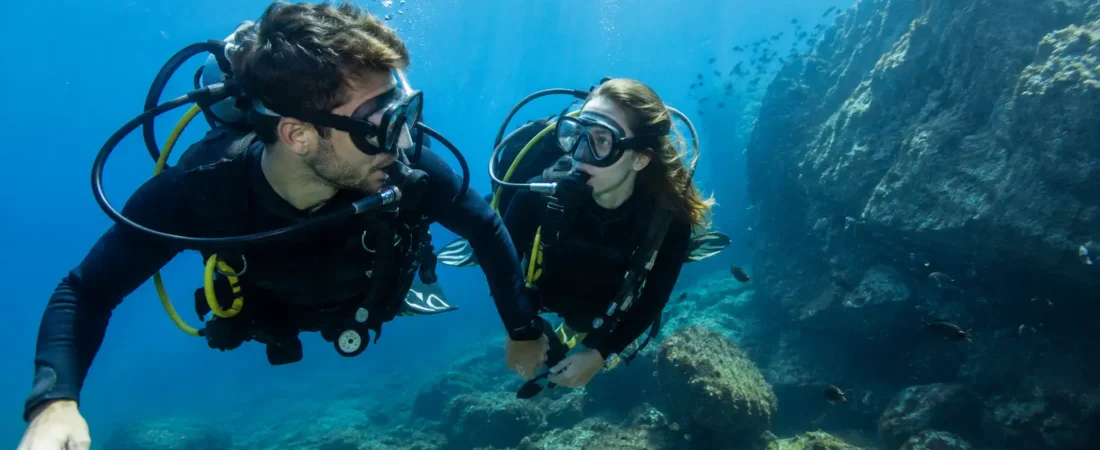
A first dive can feel very different when the person beside you is your partner. One of you may be excited; the other may be quietly worried about breathing underwater, equalising ears or simply not wanting to hold anyone back. That is why the best diving for couples is rarely the biggest boat trip or the cheapest group offer. It is an experience where you can both slow down, ask questions and enjoy the sea at a pace that feels right.
In South Tenerife, a private scuba experience makes that possible. The water is often comfortable year-round, many dive locations are close to Los Cristianos and Costa Adeje, and the volcanic coastline offers sheltered areas suited to both new and experienced divers. The key is choosing the format that matches the two of you, rather than booking the same activity everyone else is doing.
What makes the best diving for couples?
For couples, personal attention changes the whole experience. In a large group, an instructor has to divide their focus between several people with different confidence levels. Briefings can feel rushed, and the dive follows a fixed schedule. That may work well for confident, certified divers travelling with friends, but it is not always ideal when one partner is a complete beginner.
A private instructor can explain each part of the experience clearly, check that both of you are comfortable and adapt the pace underwater. You have time to practise breathing with the regulator in shallow water, adjust your mask if needed and descend only when you are ready. If one person needs a little longer, the other is not left waiting with strangers.
Privacy is also about enjoyment, not only reassurance. A calm underwater moment together, without a crowd of divers around you, often becomes one of the most memorable parts of a Tenerife holiday. Photos can be a lovely addition too, particularly for a first scuba experience, but they should never distract from comfort and safety.
If neither of you has dived before
A private try dive is usually the best starting point. You do not need previous diving experience or a scuba qualification. Before entering the water, your instructor introduces the equipment, explains the basic signals and shows you how breathing underwater feels. The aim is not to turn the session into a classroom. It is to give you the knowledge needed to feel calm and safe.
The most reassuring beginner experience begins in shallow water. You can stand up, take your time and get used to the mask, fins and regulator before moving farther out. Once you are comfortable, the instructor stays close throughout the dive and manages the practical details, allowing you to focus on the scenery and on each other.
It helps to be honest when booking. Mention if either of you is nervous in deep water, has not swum recently or is concerned about ears. Those concerns do not automatically mean scuba diving is unsuitable, but they do affect how the experience should be planned. A responsible instructor will ask relevant health questions and will not pressure you to continue if you do not feel well or comfortable.
A try dive is not the same as a certification course. It is a supervised introduction to scuba diving, designed to let you experience the underwater world without committing several days of your holiday. For many couples, that is exactly the right balance.
When one partner is certified and the other is not
This is a common situation, and it deserves a flexible answer. A certified diver may be tempted by deeper sites or longer guided dives, while their partner wants a gentle first experience. Trying to combine both into one standard group dive can leave one person feeling rushed and the other underwhelmed.
A private operator can often plan the session around both needs. The certified diver can enjoy being back underwater while the beginner receives close supervision at an appropriate depth and pace. What is possible depends on conditions, qualifications and the specific site, so it should be discussed in advance rather than assumed.
If you each want a different kind of dive, it can also be better to arrange separate experiences. There is no rule saying a holiday activity has to be identical to be shared. One person may enjoy a guided dive with a buddy or instructor, while the other chooses a private try dive later that day or on another day. The best choice is the one that leaves both of you looking forward to it.
For two certified divers, choose guidance over crowds
Certified couples have more options, but a guided private dive still offers real advantages. Tenerife’s underwater landscape is shaped by volcanic rock, reefs, lava formations and sheltered bays. Local knowledge matters when choosing a site for the day, especially as sea conditions can change.
A good guide considers your certification level, recent diving experience, air consumption and what you would genuinely like to see. Perhaps you prefer an easy shore dive with plenty of time to look around. Perhaps you have limited holiday time and want a well-organised dive near your accommodation in Los Cristianos, Playa de las Américas or Costa Adeje. A private plan is not about making the dive complicated. It is about making it fit.
Marine life is always a possibility rather than a promise. Divers in Tenerife may encounter colourful fish, octopus, cuttlefish, rays and, on some dives, turtles. Conditions, season and luck all play a part. An experienced local guide will help you observe respectfully and point out details that are easy to miss, without making unrealistic guarantees.
Small details that make a private dive more relaxing
The practical side of a diving day matters more than most people expect. When comparing scuba diving in South Tenerife, ask what is included and how the session is organised. Quality equipment should be correctly fitted, and beginners should not feel hurried while putting it on. Transport can be useful if you are staying locally and do not want to navigate unfamiliar roads or carry anything yourself.
Think about timing as well. Do not plan a demanding day trip immediately before your dive if it will leave you tired or dehydrated. Eat lightly, drink water and allow enough time afterwards to relax. Scuba diving also has important flying-after-diving considerations, so it is wise to schedule your underwater experience before your final travel day rather than at the last minute.
Communication is another practical comfort. If you feel more at ease speaking French or English, choose an instructor you can understand easily during the briefing and in the water. Clear communication is part of safety, but it also helps nervous divers feel looked after from the first conversation.
How to choose your Tenerife diving experience together
Before booking, talk about what each of you actually wants from the day. Are you looking for a calm first experience, a shared activity with photographs, or a proper guided dive for qualified divers? Do either of you have worries about water confidence, ears or sea sickness? These are useful details, not embarrassing ones.
Then look for a provider that keeps groups small or offers a genuinely private format. Ask whether the instructor will be dedicated to you, whether equipment is included, where the dive is likely to take place and what happens if conditions are not suitable. The clearest answers are usually a good sign.
There is no need to prove anything underwater. The right diving experience lets you enjoy the excitement of trying something new while knowing that someone experienced is paying close attention. For a couple visiting Tenerife, that sense of calm can turn a few hours in the sea into the holiday memory you keep talking about long after you are home.