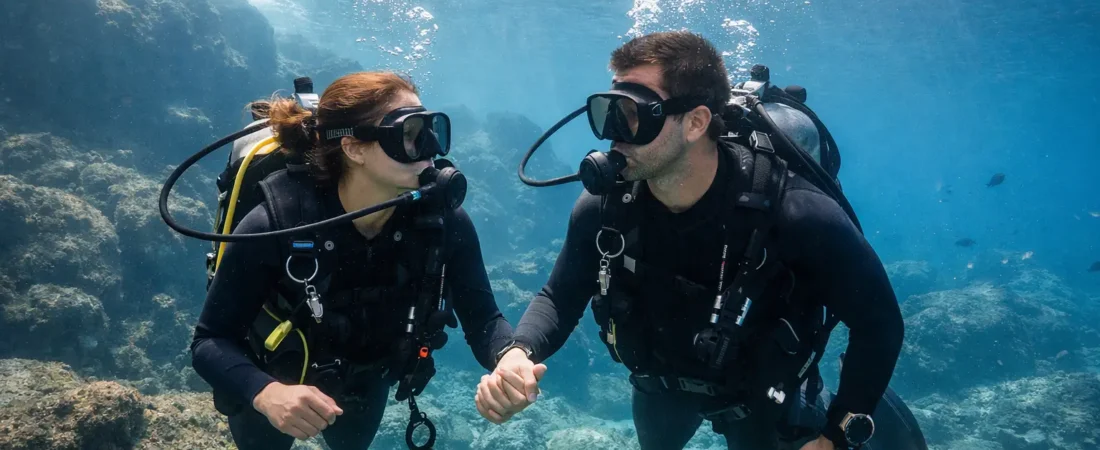
The moment you first breathe underwater is memorable on its own. Sharing it with the person you chose to travel with can make it feel even more special: a quiet look through your mask, the surprise of weightlessness, and the sense that you have stepped into a completely different Tenerife together.
To learn scuba as a couple, you do not need previous experience, athletic confidence or a long list of equipment. You do need time, patient guidance and an environment where both of you can progress at a pace that feels comfortable. For many couples, a private first dive is the most relaxed way to discover whether scuba diving is something they would like to take further.
Why learning scuba together feels different
A first scuba experience is often emotional in the best sense. One partner may be immediately at ease in the water while the other needs a little longer to settle into breathing through a regulator. That is normal. Learning together means you can encourage each other without feeling rushed, while still receiving individual attention from your instructor.
It is also an experience that asks you to slow down. Once underwater, conversation becomes simple hand signals and shared observations. You notice the volcanic shapes, changing light and small movements around the reef with more focus than you might on land. Couples often remember this calm, connected feeling as clearly as the photographs from the day.
The key is not to treat scuba diving as a test you must pass together. You are two people having the same experience, but you may not have the same reactions at every moment. A thoughtful instructor recognises this and adapts the session to each person.
Learn scuba as a couple with private guidance
Private instruction is particularly valuable for beginners travelling as a couple. Before entering the sea, your instructor explains the equipment in clear language and shows you how to breathe, communicate and move comfortably underwater. There is no need to memorise technical theory before you arrive. The focus is on the skills that make your first experience feel safe and manageable.
You will have time to try breathing with the regulator in shallow water and practise a few straightforward exercises. These are not there to make the experience formal or intimidating. They are practical reassurance: you learn what to do if water enters your mask, how to clear your regulator and how to signal that you are comfortable.
A calm pace matters. If one of you wants an extra minute to practise, that should be easy to arrange. If you are both ready, the instructor can lead you gradually into the underwater landscape. Good guidance creates space for confidence to build naturally rather than expecting it to appear immediately.
At Lov’Ocean, the aim is to keep this process personal, clear and unhurried. Equipment is included, and underwater photos allow you to stay present in the moment rather than worrying about capturing it yourselves.
What your first couples’ scuba session can look like
Your experience usually begins with a friendly conversation about your swimming comfort, any concerns and what you hope to get from the session. You do not need to be an expert swimmer, but you should feel reasonably comfortable in the water and be able to follow your instructor’s guidance.
After fitting your mask, fins, wetsuit and scuba equipment, you receive a concise briefing. You will learn the essential hand signals, how the equipment works and the simple rules that keep a first dive safe. Your instructor then stays close as you enter the water and become familiar with breathing underwater.
The first few breaths can feel unusual. For some people, they are exciting from the start; for others, it takes a few quiet minutes for the body to relax. Both responses are completely valid. Once you feel settled, you can begin to explore at an appropriate depth, always with your instructor nearby.
Tenerife’s volcanic coastline gives these first dives a distinctive character. Rock formations, lava textures and clear Atlantic light create a setting that feels far removed from a typical beach day. Marine life is part of the experience, but it is never scripted. The sea decides what it reveals, and that uncertainty is part of its appeal.
A first dive or a full course: which suits you?
This depends on what you want from your holiday and what you hope scuba diving will become for you.
A private introductory dive is a strong choice if you are complete beginners, have limited time, or simply want to share a memorable first underwater experience. It gives you a genuine taste of scuba diving with direct support, without committing your holiday to several days of training.
A certified scuba course is better if you both already know that you want to dive independently in the future. It involves more time in the water and more structured learning, because certification carries the responsibility of preparing you to dive safely after the course. Some couples start with an introductory session and decide afterwards whether continuing feels right. Others arrive ready to begin the course immediately.
There is no better option in general. The best choice is the one that matches your confidence, available time and appetite for learning. An honest conversation with an instructor before booking can make that decision much easier.
How to prepare without overthinking it
You do not need to buy specialist equipment for a first experience. Bring swimwear, a towel and sunscreen for before and after the session. Avoid heavy alcohol the night before, arrive well hydrated, and leave enough room in your day so you do not feel rushed.
It is worth discussing any medical conditions, medications, recent illnesses or concerns such as asthma directly and openly before diving. In some cases, medical advice or approval may be needed. This is not a barrier for its own sake; it is how a professional diving experience stays safe and properly tailored to you.
If either of you is nervous, say so at the beginning. Nervousness is common, especially when breathing underwater is new. It is much more useful to share that feeling than to try to hide it. A good instructor can explain each step again, adjust the pace and help you decide whether you are ready to continue.
Making the day part of your Tenerife holiday
A couples’ scuba experience works well as more than an activity between breakfast and dinner. Give yourselves a little space around it. A relaxed morning, an unhurried journey to the coast and time afterwards to look through your photos can turn it into one of the defining moments of your stay.
For visitors staying around Los Cristianos, Costa Adeje or Playa de las Américas, a well-organised session also removes many of the practical worries. Knowing what is included, where to meet and what to bring lets you focus on the experience rather than the logistics.
Try not to place diving immediately before a flight. Scuba diving requires a sensible surface interval before flying, so plan this experience earlier in your holiday where possible. Your instructor can help clarify the timing based on your dive plan.
Give each other permission to go at your own pace
The best shared experiences leave room for individual comfort. One of you may surface thinking, “When can we do that again?” The other may feel proud simply to have taken those first breaths beneath the surface. Both are meaningful outcomes.
Learning scuba as a couple is not about proving that you are equally fearless. It is about discovering something extraordinary side by side, with the reassurance that you are supported throughout. If the idea appeals to you, choose a private experience, ask every question you have, and let the sea set a gentler pace for the day.