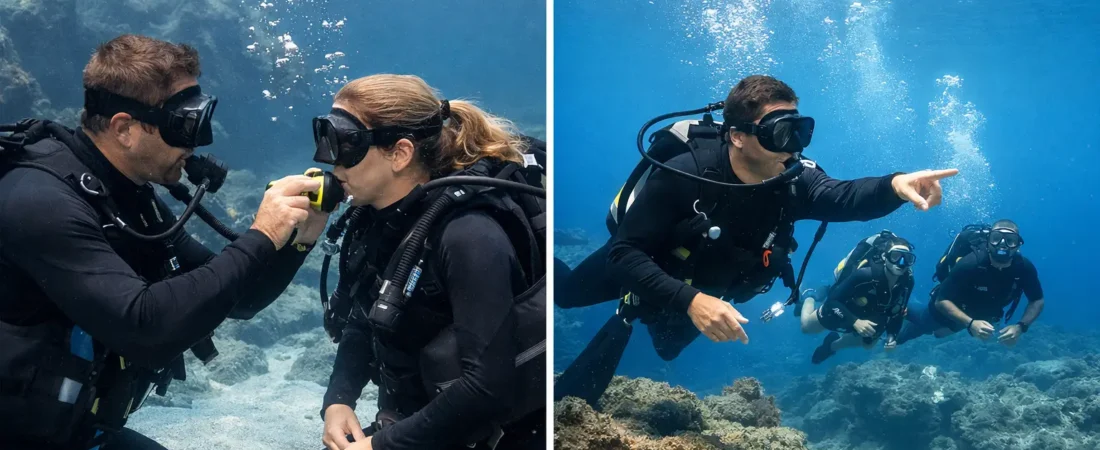
Your logbook may say certified, but that does not always mean you will feel immediately ready to descend again. Perhaps your last dive was before a busy few years, your equipment routine feels hazy, or you simply want a calm reintroduction before exploring Tenerife’s volcanic coastline. When considering a scuba refresher versus guided dive, the best choice is not about proving what you remember. It is about starting the day with the right level of confidence, comfort and support.
For some certified divers, a well-planned guided dive is all that is needed. For others, a refresher creates the breathing space to revisit essential skills before the real exploration begins. Both can lead to a memorable day underwater, but they serve different purposes.
What a scuba refresher is designed to do
A scuba refresher is a practical return to the foundations of diving. It is intended for certified divers who have been out of the water long enough to feel uncertain about the basics, or who would simply appreciate a guided reset before an open-water dive.
Rather than treating it as a test, think of it as time with an instructor to rebuild familiarity. You may revisit how your equipment is assembled and checked, how to establish relaxed buoyancy, how to clear water from your mask, recover and clear your regulator, and communicate comfortably underwater. The exact content should reflect your experience, your certification history and how you feel on the day.
This matters because confidence is practical. When fundamental actions feel natural again, there is more attention available for the scenery, your breathing and the experience itself. Tenerife’s underwater landscape can be wonderfully varied, with volcanic rock formations, clear Atlantic light and sheltered sites suited to a considered return. A refresher helps you arrive there feeling present rather than preoccupied.
A refresher may be particularly sensible if you have not dived for a year or more, if you have only made a small number of dives, or if a past dive left you feeling rushed or uneasy. It can also be reassuring when you are travelling with a partner who is more experienced than you are. There is no prize for skipping a review that would help you enjoy the dive more.
What a guided dive is designed to do
A guided dive is for certified divers who are comfortable with their core skills and want local knowledge, thoughtful planning and a relaxed route through an unfamiliar site. Your guide takes account of conditions, chooses an appropriate location and helps you make the most of the time underwater.
The purpose is exploration rather than skill practice. Before entering the water, you should still receive a clear briefing covering the plan, conditions, depth, route, communication and anything relevant to the site. During the dive, an attentive guide can set an unhurried pace, point out details that are easy to miss and adapt the plan where conditions or comfort call for it.
For divers visiting Tenerife South, this local perspective is valuable. The best site is not necessarily the most famous one. Sea conditions, visibility, your recent experience and the kind of dive you would enjoy all matter. A personal approach makes it easier to choose a route that feels right on that particular day.
A guided dive can be ideal if you have been diving regularly, recently completed dives in similar conditions, and feel comfortable managing your equipment and buoyancy. It is also a lovely option for certified couples or friends who want the simplicity of having the practical details organised, from equipment to the underwater plan.
Scuba refresher versus guided dive: the real difference
The difference is less about your certification card and more about where your attention needs to be. On a guided dive, your attention can be directed towards the environment and the pleasure of discovery. During a refresher, part of the experience is deliberately devoted to making the essential routines feel familiar again.
A guide can absolutely be patient and supportive on any dive, but a guided dive should not be used as a substitute for revisiting skills you no longer feel able to perform calmly. If you are wondering whether you can remember how to respond to a small, manageable issue underwater, that is useful information. It usually points towards a refresher.
Equally, do not assume that a long break automatically means you need an extensive session. A diver with many previous dives may only need a little extra time at the start, a careful equipment check and a gradual descent. Someone with fewer dives may benefit from more structured practice even after a shorter break. This is why an honest conversation before booking is more helpful than a fixed rule.
Questions worth asking yourself before you book
Start with the last time you dived. Can you remember your basic equipment routine without feeling flustered? Do you feel at ease clearing a mask, breathing from a regulator and maintaining neutral buoyancy? Would you be relaxed if visibility changed slightly or if you needed to pause and communicate with your instructor?
Your answers do not need to be perfect. They simply help define the support that will make your day enjoyable. If you feel mostly comfortable but would welcome a few reminders, a personalised guided dive with a slower start may be suitable. If several basics feel uncertain, choose a refresher and give yourself that extra margin.
It is also worth considering your goals. If this holiday dive is important to you, perhaps because you are returning to the sea after a long time or sharing the experience with someone special, setting aside time for reassurance is often the better choice. A little preparation can make the rest of the experience feel beautifully uncomplicated.
Why personal guidance changes the experience
A return to scuba is rarely only about skills. Many divers are also adjusting to a new destination, different equipment or the natural nerves that can appear after time away. A calm instructor can make a substantial difference by explaining each stage clearly, allowing time for questions and responding to how you feel rather than pushing a preset pace.
At Lov’Ocean, the focus is on a private, tailored experience where comfort and safety guide the plan. Equipment is provided, and practical arrangements can be kept simple, so your energy stays with the part that matters: reconnecting with the water. Underwater photos can also be included, leaving you with a genuine record of the day rather than a hurried memory.
Personal attention does not mean removing all challenge from diving. It means choosing an appropriate challenge. For one diver, that may be calmly repeating a mask-clear in shallow water. For another, it may be following a new volcanic route with the confidence that a knowledgeable guide is beside them. Both are valid ways to grow.
How to make your return comfortable
Tell your instructor when you last dived and be candid about any skills you would like to revisit. This is not something to minimise. Clear information allows the session to be planned around you from the outset.
Arrive with enough time to avoid feeling hurried, and let the equipment fitting be part of the experience rather than an obstacle before it. A well-fitting mask, fins and exposure suit make an immediate difference to comfort. If anything feels wrong, say so before entering the water.
Once underwater, keep the first few minutes simple. Slow breathing, an easy descent and a moment to settle can transform how the rest of the dive feels. There is always value in pausing, checking in and adjusting the plan. The sea will still be there.
The right choice between a refresher and a guided dive is the one that lets you look up from the details, breathe steadily and enjoy the volcanic world around you with genuine ease.