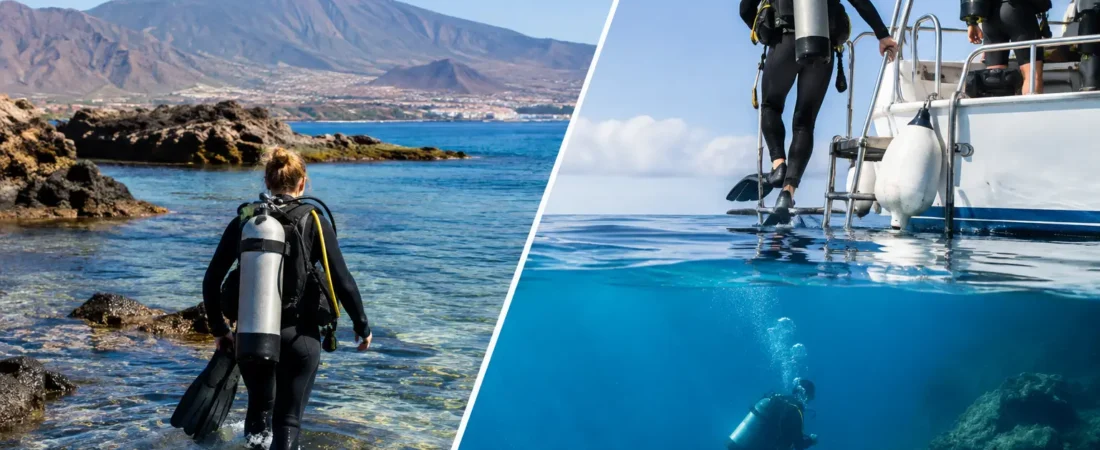
Tenerife’s underwater world begins closer to shore than many visitors expect. The question of shore diving versus boat diving Tenerife is not really about which option is better overall. It is about which setting will help you feel most comfortable, relaxed and ready to enjoy the experience.
For a first dive, a guided exploration or a private course session, the best choice depends on your confidence in the water, the conditions on the day and the kind of memory you want to take home. Both options can reveal volcanic landscapes, clear Atlantic water and fascinating marine life. The difference is in how you arrive, how the dive unfolds and how much time you have to settle into the moment.
Shore diving versus boat diving Tenerife: the real difference
Shore diving starts from the coast. After a careful briefing and equipment check, you enter the water gradually from a beach, a sheltered bay or a suitable coastal access point. There is no rush to board a boat or adapt to a fixed departure schedule. For many guests, this calmer beginning makes a meaningful difference.
Boat diving takes you to a site reached from the sea rather than from land. The journey itself can be part of the pleasure: open views of Tenerife’s coastline, a quiet pause before the dive and access to locations that are not practical from shore. Once at the site, you enter directly from the boat and descend into a different part of the island’s underwater terrain.
Neither choice automatically delivers a better dive. Sea state, visibility, your experience level and the specific site matter more than the entry method alone. A well-chosen shore dive on a calm day can be extraordinary. Equally, a boat dive can be the right option when it provides access to a site that suits your interests and ability.
Why shore diving often suits first-time divers
A private beginner experience should feel unhurried from the first conversation to the final photo. Shore diving supports that pace particularly well. You can take time to become familiar with the mask, regulator and breathing before heading into deeper water. The gradual entry gives many first-time divers a reassuring sense of control.
This is especially valuable if you feel excited but slightly nervous. You do not need to manage a moving boat, step into the sea from a platform or worry about timing an entry with the swell. Instead, your instructor can stay close, repeat anything that needs clarifying and adapt the rhythm to you.
Tenerife’s southern coast offers sheltered areas that can be very suitable for introductory diving, depending on conditions. Around locations such as Los Cristianos, Costa Adeje and Palm-Mar, the volcanic coast can offer underwater rock formations, darker lava textures and shoals of fish within a manageable depth range. The exact site should always be selected according to the weather, sea conditions and your comfort on the day.
For certified divers, shore diving can also be a wonderfully simple choice. There is something special about walking into the Atlantic and finding a volcanic reef only a short swim away. You spend less time travelling to the dive site and more time focused on the underwater environment.
The practical advantages of starting from shore
A shore dive is often easier to organise around a holiday schedule, particularly when you want a personal experience without making a full day of it. It can also feel more relaxed after a long journey or for anyone who is unsure how they will feel on a boat.
The entry may involve walking over sand, rocks or steps, depending on the location. This is worth discussing honestly in advance if mobility is a concern. A considerate instructor will choose the most appropriate access point, help with equipment and explain what to expect before you arrive at the water.
The main advantage is not simply convenience. It is the ability to slow down. For a private baptism or a confidence-building session, that extra space can turn apprehension into genuine enjoyment.
When boat diving is the better fit
Boat diving comes into its own when the most suitable site lies beyond the shoreline. Tenerife has a varied underwater coastline, and travelling by boat can open up different reef structures, deeper volcanic formations and areas less frequently reached from land.
For experienced or certified divers, this variety can be a strong reason to choose a boat trip. You may be looking for a particular type of topography, a slightly more remote feel or simply the pleasure of arriving at a site surrounded by open water. The boat journey also offers a chance to see the island from a fresh perspective before descending below the surface.
Boat diving can be appropriate for beginners too, but it is best for those who are comfortable with the idea of being at sea and happy to follow a more structured sequence around boarding, briefing and entry. A calm sea helps, of course, but personal comfort matters just as much.
Some guests find the boat ride adds excitement. Others prefer to keep their first underwater experience as simple as possible. There is no prize for choosing the more adventurous-sounding option. The right dive is the one that lets you breathe easily, listen carefully and enjoy what is in front of you.
What to consider before booking a boat dive
The sea can feel different from the coast. Even on a pleasant day, gentle movement on the boat may not suit everyone. If you are prone to seasickness, mention it when planning your dive. Simple preparation, including eating lightly and arriving well rested, can help, but an honest conversation allows the experience to be designed with your comfort in mind.
Boat diving also requires more flexibility around weather and marine conditions. Safety always comes first, and the planned site may need to change if conditions are not suitable. This is not a disappointment or a compromise. It is how a responsible dive is organised around the sea rather than against it.
Marine life: look for the setting, not a promise
Whether you enter from shore or boat, Tenerife’s marine life is shaped by seasons, currents, light and luck. You may see colourful fish moving over volcanic rock, curious octopus, rays resting in the sand or other unexpected moments, but wildlife should never be treated as a guarantee.
Shore sites can be rich in life because reefs, rocky edges and sandy patches create many places for animals to feed and shelter. Boat-accessed sites may offer different habitats and a stronger feeling of discovery, but they do not automatically mean more wildlife.
A good guide helps you notice what is actually there: the camouflage of an octopus, the changing colours of a fish against black lava, the movement of a small shoal in the blue. These details often become the most memorable part of the dive.
Choosing the experience around you
If you are completely new to scuba diving, start by asking how you want to feel. If your answer is calm, supported and able to take things slowly, a private shore dive is often an excellent place to begin. Equipment can be prepared for you, each step can be explained clearly and there is time to adjust without pressure.
If you are certified and want to explore a different side of Tenerife beneath the surface, boat diving may offer the variety you are looking for. It can also suit confident beginners who enjoy being on the water and are ready for a little more structure around the experience.
At Lov’Ocean, the decision is approached personally rather than treated as a standard package. Your instructor can consider your certification, previous experience, holiday plans and comfort in the sea, then recommend the option that makes the most sense for that day. Equipment, clear guidance and underwater photos are part of creating an experience that feels looked after from start to finish.
Let the conditions guide the day
The most rewarding Tenerife dive is rarely chosen by a label alone. A sheltered shore entry may be perfect one day, while a boat-accessed site may be the better choice on another. By staying flexible and putting comfort before a fixed plan, you give yourself the best chance of a calm, personal and unforgettable time underwater.
When you are ready to plan your dive, share how much experience you have and what would help you feel at ease. The sea will set the scene, but thoughtful guidance will help make it yours.