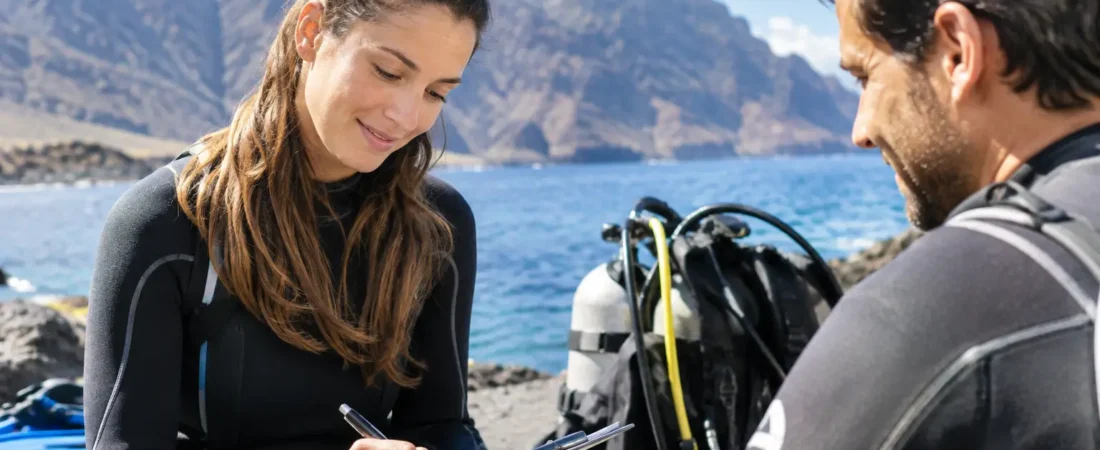
A scuba medical questionnaire is often the first safety step before getting into the water. It is not designed to catch you out or make a first dive feel complicated. It helps your instructor understand whether diving is appropriate for you on that day and whether a little extra medical guidance is needed first. This scuba medical questionnaire guide explains how to approach it calmly, honestly and with confidence before your Tenerife experience.
For many guests, the form takes only a few minutes. For others, one answer may mean speaking with a doctor before diving. Neither outcome is a judgement. It is simply part of creating a relaxed, well-organised experience where you can focus on the underwater world rather than worry about your wellbeing.
What is a scuba medical questionnaire?
A scuba medical questionnaire is a confidential health screening form completed before a dive course, guided dive or introductory experience. Its purpose is to identify conditions that could be affected by pressure changes, breathing compressed gas, exertion, water entry or the need to equalise your ears and sinuses.
The precise questions can vary according to the training organisation and the type of activity, but the principle remains the same: answer based on your current health and medical history, not on what you hope the answer will be. Your instructor will review the form and explain the next step in clear terms.
Often, a straightforward questionnaire with no relevant medical history is all that is required. If you answer yes to certain questions, you may need written clearance from a doctor before entering the water. That is a sensible precaution, not an automatic refusal to dive.
Why honest answers make for a better dive
It can be tempting to dismiss a past condition because it feels resolved, or to leave out a medication because it seems unrelated. Please do not. An instructor is not there to diagnose you, and a questionnaire cannot replace medical advice. But complete information allows the activity to be planned responsibly.
This matters especially on holiday. A late night, dehydration, a head cold, an unfamiliar medication or a demanding day in the sun can change how you feel. A private experience gives your instructor time to listen, answer questions and adapt the pace, but it does not remove the need to be medically fit to dive.
Being open early also protects your plans. If medical clearance is likely to be needed, arranging it before your travel dates can avoid disappointment on the day. It is far easier to deal with a question at home than when you are already looking forward to the coast at Los Cristianos or Costa Adeje.
What the form may ask about
Most dive medical forms cover major areas of health that can influence safety underwater. You do not need medical expertise to complete them. Read each question slowly and answer truthfully, including conditions that are controlled or treated.
Common areas include your heart and circulation, lungs and breathing, ears and sinuses, brain and nervous system, mental health, diabetes, recent surgery and current medicines. The form may also ask about asthma, seizures, fainting, panic attacks, chronic pain, mobility limitations and pregnancy.
A “yes” answer does not always mean you cannot dive. Controlled asthma, for example, may be compatible with diving for some people, but the decision depends on symptoms, treatment, medical history and a doctor’s assessment. The same applies to many other conditions. There is no responsible one-size-fits-all answer online or at a dive centre.
Ears, sinuses and respiratory symptoms
Equalising the pressure in your ears is a normal part of descending. If you have a cold, blocked nose, sinus pain, ear infection or difficulty clearing your ears, diving may need to wait. Forcing equalisation can cause injury and turn an enjoyable experience into an uncomfortable one.
Do not take a decongestant simply to push through symptoms without medical advice. Its effects can wear off during the dive, and the underlying congestion may still cause difficulty. If you wake up unwell, say so. Postponing is sometimes the best decision, particularly for a first dive.
Heart, lung and neurological history
Conditions affecting breathing, circulation, consciousness or neurological function deserve particular care. This includes chest pain, heart surgery, irregular heartbeat, significant breathlessness, a history of collapsed lung, epilepsy, stroke or unexplained blackouts.
A doctor who understands your individual history is the right person to advise on fitness to dive. If they provide clearance, bring it with you in writing if requested. Never stop or alter prescribed medication to make a questionnaire easier to complete.
Mental wellbeing and confidence in the water
Diving should feel calm, supported and manageable. Anxiety, panic attacks, claustrophobia or a recent period of poor mental health do not define you, but they may be relevant to a setting where clear breathing and composure matter.
Be honest with both your doctor and instructor. In a private introductory session, there is time to begin gently in shallow water, practise breathing through the regulator and only continue when you feel comfortable. Yet if you are currently unwell or distressed, waiting may be the more caring choice.
When should you seek medical clearance?
Seek advice from a doctor before diving whenever the questionnaire instructs you to do so. This is particularly relevant if you have an ongoing medical condition, have recently had surgery or hospital treatment, take regular prescription medication, or have had a significant change in health since you last dived.
It is also wise to ask well in advance if you are returning to diving after a long break with new health considerations. A doctor may decide that you are fit to dive without restrictions, recommend specific limits, ask for further assessment, or advise against diving. Follow that advice even if you feel perfectly well on holiday.
For the most useful appointment, explain that you plan to scuba dive rather than simply saying you are doing water sports. Take the questionnaire with you where possible and describe the planned activity honestly. A gentle, professionally supervised first experience and a more demanding dive trip are not the same thing.
How to complete your questionnaire without stress
The simplest approach is to complete the form before your activity rather than rushing through it at the meeting point. Set aside a few quiet minutes, read every question and check the wording with a family member if they know details of your medical history better than you do.
Have the names of your medications and any relevant medical documents available. If English is not your first language, ask for clarification rather than guessing. A good instructor would always rather explain a question twice than work with incomplete information.
If a doctor’s approval is required, make sure it is obtained before the dive date and bring a copy. Keep in mind that final participation can still depend on how you are feeling on the day. A new cough, ear pain, fever, severe fatigue or illness after a night out may be a reason to reschedule, even with prior clearance.
Your health check is part of personalised care
At Lov’Ocean, the medical questionnaire is treated as a conversation, not paperwork to rush through. For a beginner, it sits alongside a clear briefing, equipment chosen for comfort, unhurried skills practice and close instructor support. For certified divers, it helps ensure that the planned dive is appropriate for the day.
This personalised approach is valuable because no two guests arrive with the same experience, confidence or health background. Some are confident swimmers who have never breathed underwater; others are experienced divers returning after years away. The right pace is the one that keeps safety and enjoyment together.
A final thought before your Tenerife dive
Completing a medical form honestly is one of the best ways to protect the experience you came for. If you have a question about a health condition, raise it before booking rather than carrying uncertainty into the water. With the right advice, enough preparation and an instructor who takes time to listen, you can arrive ready to enjoy the quiet, colourful volcanic seascapes of Tenerife with real peace of mind.