Your first breath underwater can feel wonderfully quiet, slightly surreal and far more natural than you expected. But before booking, it helps to understand the difference between a discover scuba versus certification course. Both are designed for people with little or no diving experience, yet they lead to very different outcomes.
A Discover Scuba experience is a carefully supervised introduction: a chance to try scuba diving in the sea with an instructor beside you. A certification course is a learning journey that gives you the skills and qualification to dive as a certified diver afterwards. The right choice depends less on confidence than on what you want from your holiday in Tenerife.
Discover Scuba versus certification course: the essential difference
Think of a Discover Scuba experience as your first encounter with scuba. You receive a clear briefing, learn a few essential skills in shallow water and then enjoy an instructor-led underwater experience at a comfortable pace. It is not a diving licence, and that is exactly the point. There is no pressure to learn everything at once or to prove that you are ready for future dives without direct supervision.
A certification course, often called an Open Water course, is structured training. It includes learning the principles that keep diving safe, practising key skills, and completing supervised dives that show you can apply those skills calmly. Once the course is successfully completed, you receive a recognised certification that can be used when arranging recreational dives in many destinations.
Neither option is better in every situation. One is made for discovery; the other is made for progression.
Choose Discover Scuba when you want a first underwater memory
Discover Scuba is usually the best fit if you are on holiday, curious about diving and unsure whether it will become a hobby. It lets you experience the feeling that draws people back to the ocean: weightlessness, the slow rhythm of breathing and the unexpected detail of a volcanic reef.
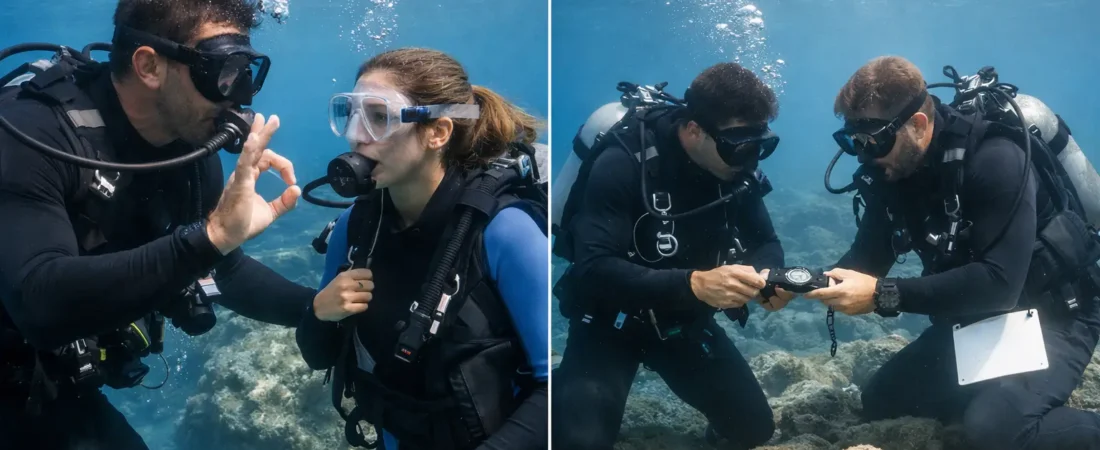
You do not need previous scuba experience. Your instructor explains the equipment in simple language, checks that you are comfortable and stays close throughout the experience. Before entering deeper water, you practise the few skills that matter most, such as breathing through the regulator, clearing water from your mask and communicating underwater.
This approach suits guests who value reassurance. You are not expected to memorise a textbook or complete several days of training while trying to enjoy the rest of your stay. Instead, the experience is shaped around your comfort, the sea conditions and the time you have available.
For many first-time divers, privacy makes a genuine difference. With dedicated attention from an instructor, there is more time to ask questions, pause when needed and move at a pace that feels right. At Tenerife Scuba Diving, equipment is included and underwater photos are part of the experience, so you can stay present rather than worrying about documenting the moment yourself.
Discover Scuba can also be a thoughtful choice for couples or friends travelling together, especially when one person feels excited and the other feels nervous. The aim is not to rush anyone into a course. It is to make that first experience calm, well organised and memorable.
Choose a certification course when you want to keep diving
A certification course is the right direction if scuba diving is more than a holiday activity on your list. Perhaps you have always wanted to learn, you plan to visit other coastal destinations, or you would like the freedom to join guided dives as a qualified diver in the future.
The commitment is naturally greater. You will need to set aside more time and arrive ready to learn. There are knowledge-development sections, practical exercises and a series of qualifying dives. This is not difficult because it is overly technical; it is thorough because safe diving depends on understanding what you are doing and developing calm habits underwater.
A good course should still feel personal. Learning rates vary. Some people feel immediately at ease breathing underwater, while others need more time with mask skills or buoyancy. A patient certified instructor adapts explanations, gives you space to practise and ensures you are genuinely comfortable before moving forward.
The reward is lasting. Certification gives you a foundation for future diving holidays and opens the door to guided exploration of sites appropriate to your qualification. Tenerife is a particularly inspiring place to learn, with volcanic underwater landscapes, clear Atlantic light and a variety of accessible coastal environments.
It is worth being realistic, though. A course should not be squeezed into an already crowded itinerary simply because certification sounds more impressive. If you only have one free morning, or if you are uncertain about the experience itself, a Discover Scuba session may be the more enjoyable and sensible first step.
Time, confidence and holiday plans matter most
When deciding between the two, start with your intention rather than your nerves. Nervous beginners can complete certification courses very successfully when they have enough time and patient support. Confident swimmers may still prefer a Discover Scuba experience if they only want to try diving once.
Consider how much of your holiday you would like to dedicate to learning. Discover Scuba is a focused experience, while a course requires sustained attention over several sessions. Both involve paperwork and a health questionnaire, and certain medical conditions or recent health concerns may require clearance from a doctor before diving. Being open about your health helps your instructor plan safely and advise you properly.
Swimming ability also matters, particularly for certification. You do not need to be an elite swimmer, but you should be comfortable in the water and willing to complete the required water-based exercises. For a first introductory experience, the instructor will explain the relevant expectations clearly before you book.
Your plans after Tenerife are another useful guide. If you can picture yourself arranging dives on future holidays, certification is an investment in something you may enjoy for years. If your goal is to share one exceptional ocean experience with a partner, celebrate a special occasion or see how it feels to breathe underwater, Discover Scuba offers a complete experience in its own right.
What your first session should feel like
Whether you choose an introduction or a course, the standard of care matters. Your diving day should begin without confusion or unnecessary rush. You should know where to meet, what to bring and what will be provided. Equipment should be selected carefully for you, and the briefing should make sense before you enter the water.
Underwater, a good instructor does more than lead the route. They watch how you are feeling, communicate clearly and make small adjustments that help you relax. If you need another moment on the surface, that is part of the process. Comfort is not separate from safety; it supports it.
The sea around southern Tenerife can offer striking volcanic formations, shoals of fish and changing textures of rock and sand. Marine life is never a promise, and the best experiences do not depend on ticking off a particular sighting. The lasting feeling usually comes from being at ease in an environment that initially seemed unfamiliar.
You can try first and decide later
There is no need to treat your first choice as a permanent decision. Many certified divers began with a single Discover Scuba experience. Trying scuba in a calm, private setting can tell you far more than reading about it: whether you enjoy the breathing, how you feel in the water and whether you would like to learn more.
If the experience leaves you wanting more time below the surface, a certification course can be the natural next step. If it remains a treasured holiday memory, that is equally valuable. Choose the option that gives you enough time to feel safe, supported and genuinely excited to enter the water.