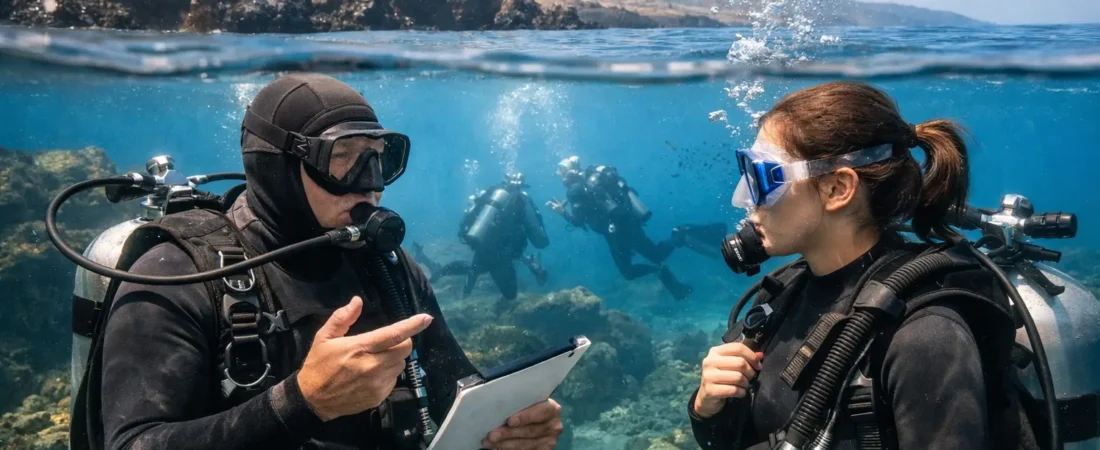
A two-day certification example can sound wonderfully simple when you are planning a Tenerife holiday: arrive, learn to dive, leave with a qualification. In practice, the best experience is simple because it has been prepared properly. Your instructor should have time to understand your confidence in the water, explain each stage clearly and adapt the pace to you, rather than rushing through a fixed timetable.
For many visitors, two days can be enough for the in-water part of an entry-level scuba course. Whether it leads to a completed certification depends on the training agency, your medical suitability, the theory completed before arrival and how comfortably you meet the required skills. That is not a complication. It is how a professional course protects both your safety and your enjoyment.
What a two-day certification example can look like
This example suits a holidaymaker who has completed the required digital learning and knowledge reviews before coming to Tenerife. They are medically fit to dive, comfortable in the water and have allowed a little flexibility in their plans. The practical sessions are private or very closely supervised, so the instructor can give calm, individual attention throughout.
Before you arrive: theory and preparation
The most useful work happens before the first day of diving. Course theory introduces the essentials: how pressure changes underwater, how to breathe correctly from a regulator, how to manage buoyancy and how to plan safely within your training limits. Completing this material in advance leaves your time in Tenerife for the part that matters most – becoming comfortable in the water.
You will also be asked to complete a medical questionnaire. Some answers may mean you need medical approval before diving. This is a normal precaution, not a reason to worry. Raising it early avoids disappointment on the day and allows the instructor to advise you honestly.
It also helps to share your swimming experience and any concerns, whether that is ear equalisation, feeling nervous in deeper water or simply not knowing what to expect. A good instructor uses this information to make the session feel more personal from the outset.
Day one: settle in, practise and build confidence
The first day begins with a relaxed briefing. You will be introduced to the equipment, shown how it fits and given time to ask questions. All equipment should be selected and adjusted for your comfort, including wetsuit, mask, fins and buoyancy device. There is no prize for moving quickly through this stage.
The initial water session focuses on the foundation skills that make scuba diving feel reassuring. You learn how to breathe calmly underwater, clear water from your mask, recover and clear your regulator, control your position in the water and communicate with hand signals. These are practised in conditions where the instructor can remain close and where you can pause whenever needed.
Once those skills begin to feel natural, the session can become a genuine dive rather than a checklist. Tenerife’s volcanic coastline offers clear, characterful underwater landscapes, but the aim on day one is not to cover distance or chase a particular wildlife sighting. It is to become settled enough to notice the colours, rock formations and quiet rhythm of being underwater.
After a proper surface interval, there may be a second session to repeat skills and develop buoyancy. Repetition is valuable. The person who needs to practise a mask-clear three times is not behind anyone else. They are learning it properly.
Day two: apply the skills on open-water dives
On the second day, the equipment routine already feels more familiar. Your instructor will review the plan, check how you felt after day one and choose a suitable site according to sea conditions and your progress. Around Tenerife South, this might mean a sheltered coastal location selected for comfort, visibility and the training objectives of the day.
The remaining open-water sessions build on the first day. You may repeat selected skills, practise controlled descents and ascents, work further on buoyancy and learn how to respond calmly to common situations under direct supervision. The focus remains on control, awareness and communication.
As your confidence grows, there is more space to enjoy the dive itself. You may see reef fish, volcanic rock textures or changing shafts of light, but nature is always nature. The most memorable part is often less about one animal and more about the moment you realise that you are relaxed, breathing steadily and moving comfortably through the sea.
At the end of the final session, the instructor reviews the course requirements with you. If every required element has been completed to the standard of the training agency, your certification can be processed. If one skill needs more time, that should be treated as useful feedback, not failure. An additional session can give you the practice needed to complete the course with real confidence.
When two days are realistic – and when they are not
A two-day schedule is most realistic when theory is complete in advance, conditions are suitable and you are able to meet the course performance requirements without needing extra practice. It may also work differently depending on the certification level and agency standards. Some courses require more scheduled training time, while others may allow practical elements to be completed efficiently after e-learning.
If you are a complete beginner who feels anxious in the water, travelling with children, or arranging your first ever holiday dive, giving yourself more than two days is often the kinder choice. A little extra time removes pressure. It lets you rest between sessions, adjust to the water temperature and enjoy the learning process rather than watching the clock.
Your wider holiday plans matter too. Avoid scheduling a course immediately before flying, as scuba diving requires an appropriate surface interval before air travel. It is wise to place your diving earlier in your stay, leaving the final day for dry-land exploring, a relaxed meal or simply enjoying the coast.
Why private instruction changes the experience
A certification course asks you to learn practical skills in a new environment. That can feel exciting and, for some people, a little exposed. Private instruction makes a meaningful difference because the schedule is built around your progress, not an arbitrary pace.
You have more opportunity to ask a question again, repeat a skill without feeling observed and take a moment if something does not feel right. The instructor can also fine-tune your equipment and buoyancy more carefully. These details create comfort, and comfort is where confidence begins.
At Lov’Ocean, the intention is to make the process feel calm, organised and personal from the first conversation. Equipment is included, planning is explained clearly, and underwater photographs can help preserve the experience once the nerves have turned into pride.
How to plan your course with confidence
Start by choosing dates that leave room in your holiday rather than squeezing diving between a late arrival and an early flight. Complete the requested learning before you travel, answer the medical questions honestly and let your instructor know if you have concerns about water confidence, equalising your ears or fitness.
Bring swimwear, a towel and a willingness to learn at your own pace. The rest should be organised for you. You do not need to arrive knowing the equipment or the terminology. You only need to be ready to listen, practise and communicate openly.
A two-day course can be a beautiful way to begin diving in Tenerife when the preparation and conditions are right. Give yourself enough space for the experience to feel unhurried, and your first qualification can become the start of many calm, confident dives to come.