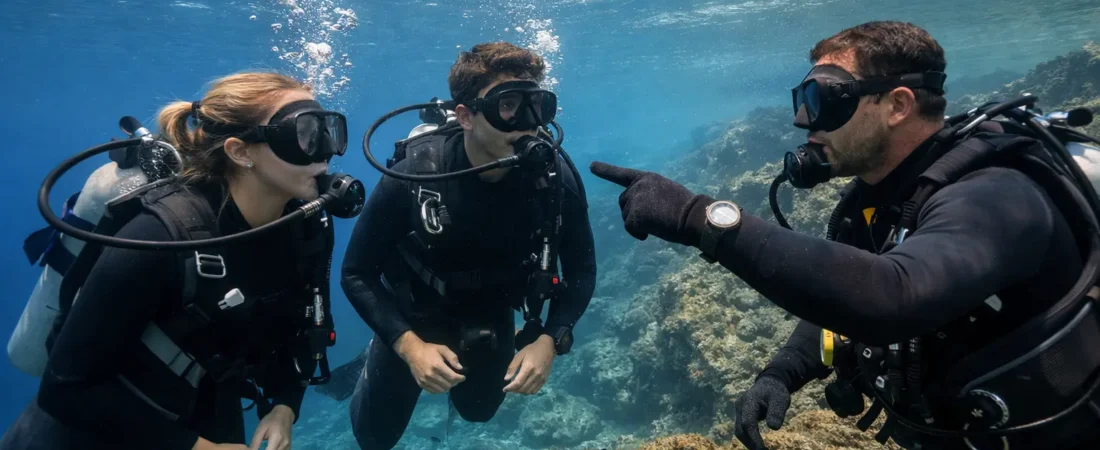
The first few moments beneath the surface are often quieter than people expect. The sound of the shore fades, your breathing becomes steady, and Tenerife’s volcanic coastline takes on an entirely different character. Searches for “diving Los Cristianos beginners” usually come from people who are excited by that idea, but unsure whether they will feel comfortable enough to try it. With patient, private guidance and a pace built around you, a first dive can feel far more accessible than it first appears.
Why Los Cristianos suits a first scuba experience
Los Cristianos is a practical base for beginners staying in the south of Tenerife. The area is close to many of the island’s southern resorts, while the surrounding coastline offers sheltered conditions on suitable days and underwater volcanic scenery that feels distinctly Canarian.
The appeal is not about rushing towards a deep or demanding dive. It is about taking time to become comfortable in clear water, with an instructor beside you from the first explanation to the moment you return to shore. Volcanic rock formations, textured seabeds and changing shafts of light create an engaging setting without requiring previous diving experience.
Conditions always matter. The sea is assessed on the day, and a responsible instructor will choose the most suitable location and plan according to weather, swell and your confidence in the water. This flexibility is one reason a personalised experience makes sense for a first dive in Tenerife.
What happens during a beginner dive in Los Cristianos?
You do not need a scuba qualification to take a supervised introductory dive. Before entering the sea, your instructor explains the equipment in plain language and shows you exactly how each part works. There is no expectation that you will remember everything immediately. The purpose of the briefing is to make the experience feel familiar before you get wet.
A calm introduction to the equipment
The mask helps you see clearly underwater, the fins help you move gently, and the regulator is the mouthpiece through which you breathe. It can feel unusual to breathe underwater for the first time, but most people adapt once they pause and take slow, relaxed breaths.
Your instructor will also explain a few simple hand signals. These allow you to communicate easily underwater, whether you are comfortable, want to slow down, or would like to return to shallower water. You will have time to practise the key skills in shallow water before the actual dive begins.
All essential diving equipment should be included and properly fitted to you. A well-fitting mask, wetsuit and fins make a meaningful difference to comfort, particularly if this is your first experience.
Your first breaths below the surface
There is no prize for being quick. Some guests feel ready almost immediately; others prefer a few extra minutes at the surface or in shallow water. Both are completely normal.
Your instructor stays close throughout the dive, helping you settle your breathing and adjust your position in the water. Once you are comfortable, the descent is gradual. You may be surprised by how calm it feels when there is no pressure to keep up with anyone else.
At a depth chosen for your comfort and the day’s conditions, you can begin to notice the details around you: rock contours shaped by volcanic activity, small fish moving across the reef and the soft movement of light above. Marine life is never a promise, and that is part of the beauty of the sea. Each dive is different.
Returning with photographs and a real memory
A first dive passes quickly because there is so much to take in. Underwater photographs give you something tangible to look back on, and they are especially valuable when friends or family want to see what you did. At Lov’Ocean, photos are included as part of the experience, so you can stay present in the water rather than worrying about capturing the moment yourself.
Why private guidance makes such a difference
For a complete beginner, reassurance is not an extra. It is the foundation of a good experience. Private diving allows the session to follow your natural pace, with attention focused on how you are feeling at every stage.
Perhaps you are confident in the sea but nervous about breathing through a regulator. Perhaps you are a strong swimmer who simply wants a clear, well-organised introduction. Or perhaps you are travelling with a partner and want to share something memorable without feeling hurried. Personalised instruction gives space for all of these situations.
It also makes the day simpler. You receive direct answers to your questions, assistance with your equipment and guidance adapted to your comfort level. The experience remains professional and carefully structured, but never impersonal.
Do you need to be a strong swimmer?
You do not need to be an athlete to try an introductory scuba experience, but you should be comfortable in the water and able to remain calm while wearing a mask. Your instructor manages the technical aspects of the dive and stays with you throughout, yet basic water confidence will help you enjoy it more fully.
Before booking, be honest about your swimming ability and any worries you have. This is useful information, not something to be embarrassed about. A good diving professional would rather understand your starting point and plan appropriately than make assumptions.
Health is equally important. You will normally complete a medical questionnaire before diving. Certain conditions, recent illnesses, ear problems, respiratory concerns, pregnancy, or some medications may mean that medical advice is needed before taking part. If you are uncertain, ask in advance rather than leaving the question until the day of your dive.
What to bring for your first dive
The practical side should be uncomplicated. Bring swimwear, a towel, sunscreen for before and after the session, and drinking water. If you wear contact lenses, tell your instructor, as some people prefer to remove them before putting on a mask.
Avoid arriving after a heavy meal or a late night with too much alcohol. Feeling rested, hydrated and unhurried makes a noticeable difference to how relaxed you feel in the water. Allow some breathing room in your holiday schedule too. A first dive is better enjoyed when it is not squeezed between other plans.
If transport is relevant to your stay in southern Tenerife, ask about arrangements when booking. Clear logistics are part of feeling at ease, especially if you are unfamiliar with the area.
First dive or scuba course: which is right for you?
An introductory dive is ideal if you want to experience scuba diving before committing to a course. It gives you a genuine taste of breathing underwater, moving through the sea and discovering whether diving is something you would like to pursue.
A course is the better choice if your aim is to gain a recognised qualification and continue diving independently with a buddy after your holiday. It involves more learning, more time in the water and a structured development of skills. Neither option is better in every case. It depends on whether you want one exceptional first experience or the beginning of a longer diving journey.
Some guests start with a private introductory dive and decide afterwards that they would like to continue. That is often the most comfortable way to make the decision, because it is based on how the experience actually felt rather than on guesswork.
Make your first dive feel simple
When you book, share the details that help shape the experience: your dates, where you are staying, whether you have any water-related anxieties, and whether you are celebrating something special. The more clearly your instructor understands what you need, the more naturally the day can be organised around you.
Choose a time when you are not due to fly soon afterwards, as scuba diving requires an appropriate interval before flying. Your instructor can advise on this based on the dive plan. It is a small but essential part of planning safely.
A first scuba dive should leave you feeling looked after, not tested. In Los Cristianos, the real luxury is having time to slow down, breathe steadily and realise that the underwater world is closer than you thought.